Tracking tells you where the bus is.
XBus tells you what happens next.

None of these are hypothetical. Every transportation director reading this has lived at least two of them this month.
An hour of re-juggling coverage from a whiteboard and somebody’s memory of who is under their hours.
“Where’s the bus?” — forty times, while the person who could answer is on another call.
A kindergartner rides back to school, and a driver makes a judgement call alone at the curb.
The bus still stops where nobody has boarded since September. Nobody told routing.
The protocol runs at both ends of every route — before the wheels turn, and after the engine stops. It is not a checklist a driver ticks from memory. It is a sequence the app will not advance through until the hardware confirms each step.

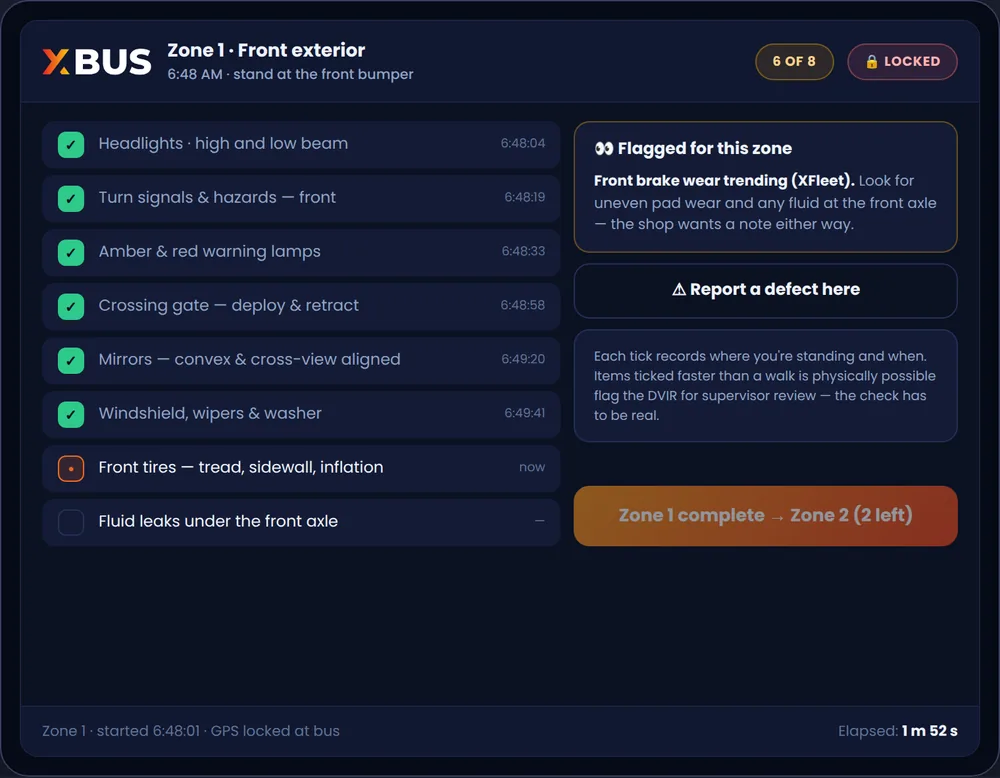
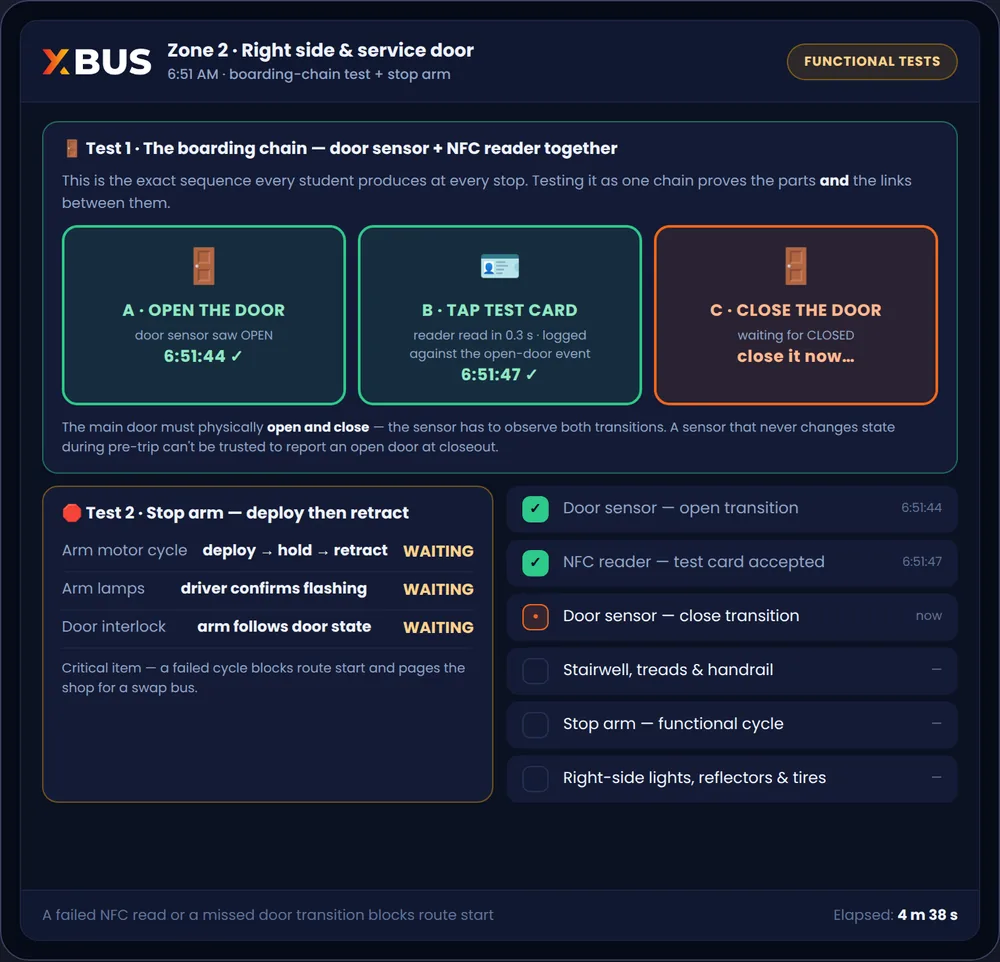
Five zones, and the app only asks for the equipment this bus actually has. The main door is physically opened and closed — the sensor must see both transitions, because a sensor that never changes state during pre-trip cannot be trusted to report an open door at closeout.

Door sensor and card reader tested as one sequence: open the door, tap a test card, close the door. That is exactly what every student produces at every stop — so testing it as a chain proves the parts and the links between them.

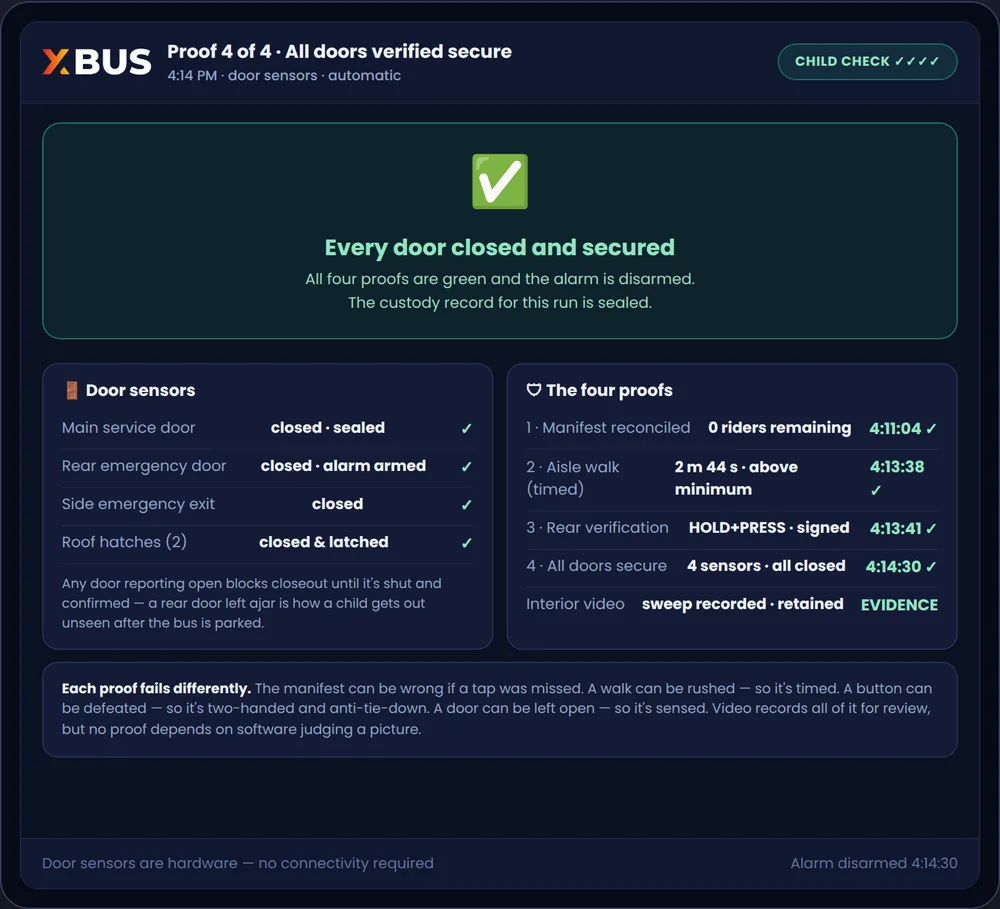
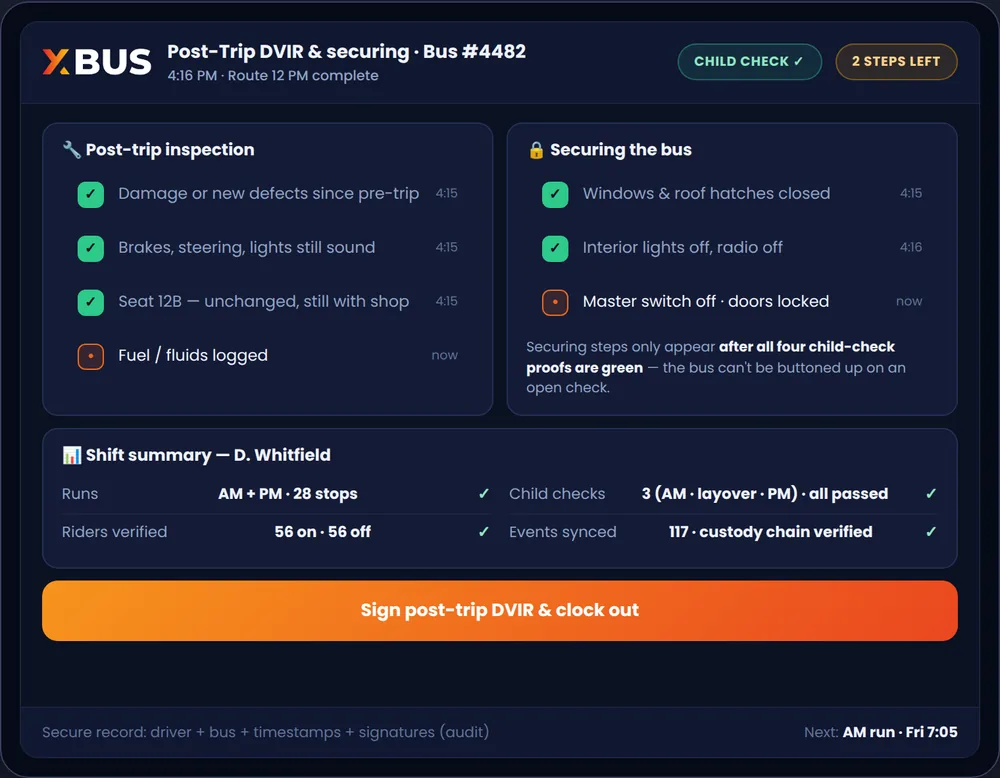
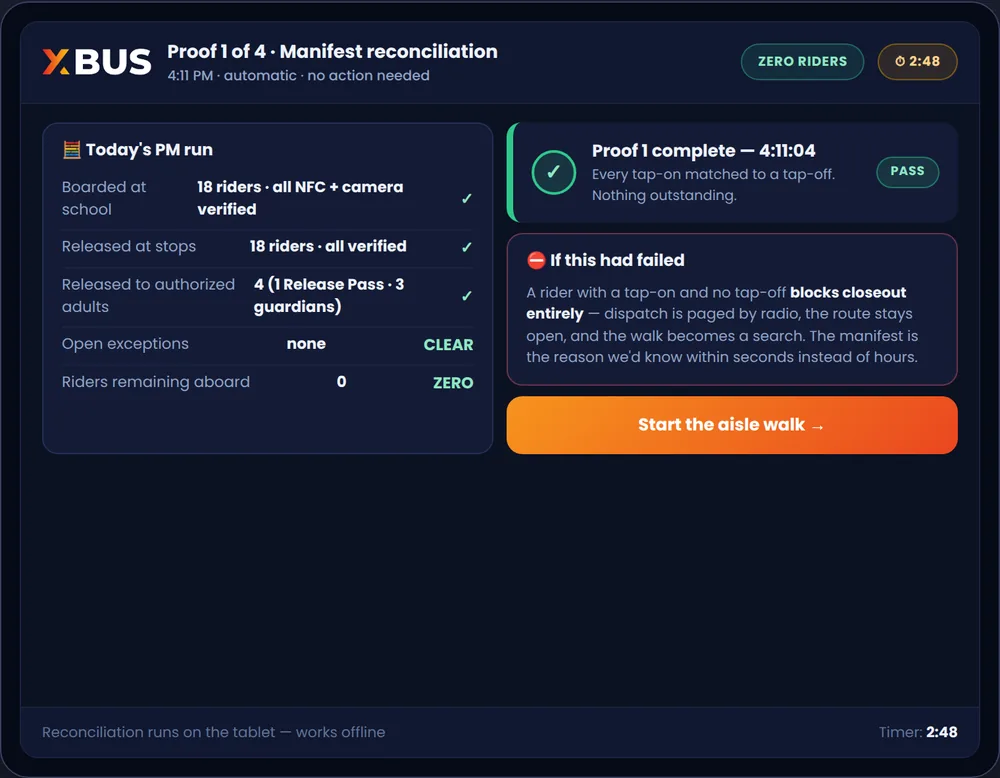
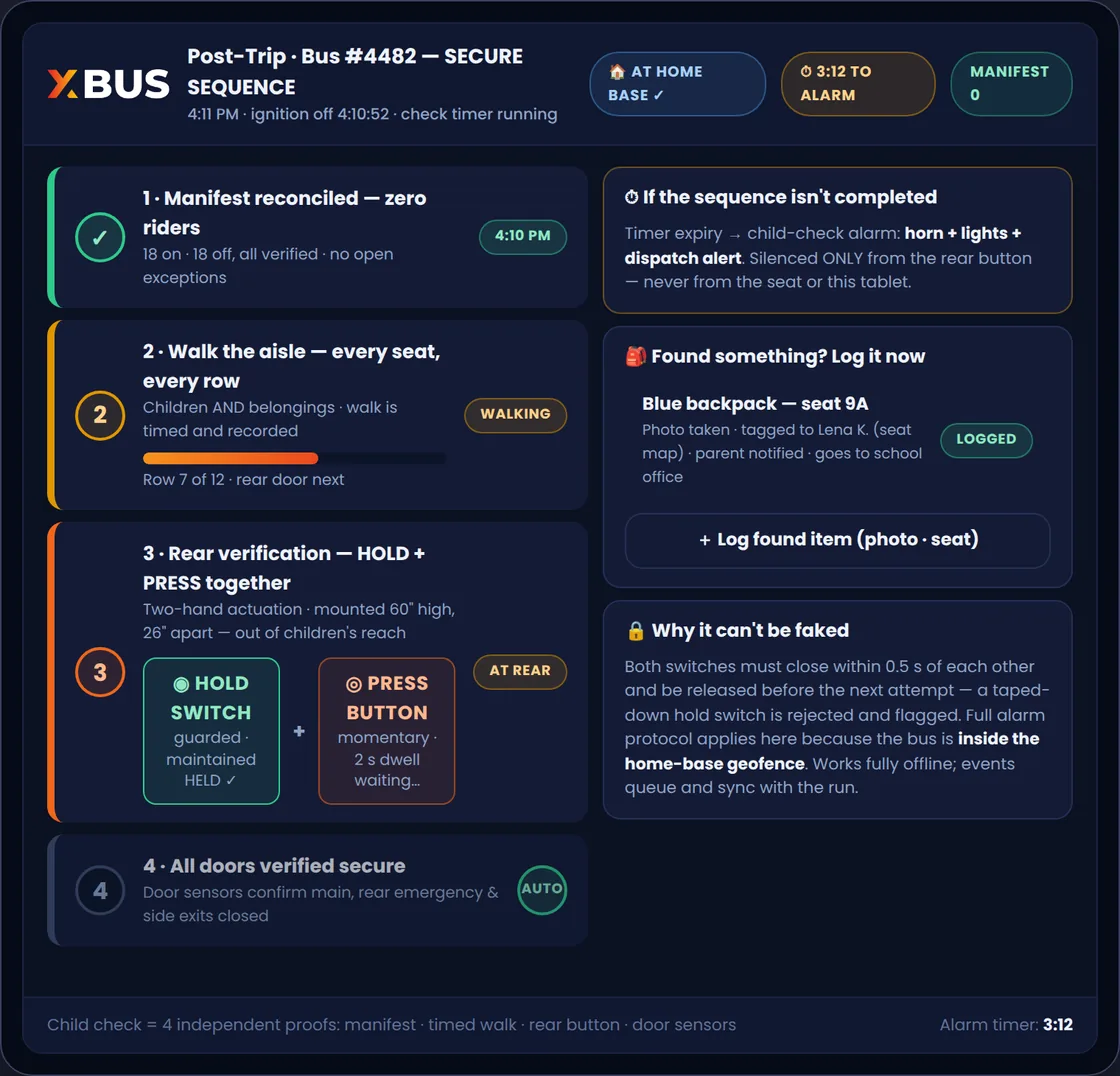
Ignition off starts the sequence. The driver cannot mark the bus secure, cannot sign out, and cannot leave the app until all four checks are green — and dispatch sees the same state in real time.
That is the point of the protocol, and it is worth being precise about how it works: XBus does not watch a bus and hope. It withholds the one thing a driver needs to finish their shift — a cleared bus — until four independent pieces of hardware agree the bus is empty and secure. A tired driver at the end of a long day does not have to remember. The system will not let the day end.
XBus is a safety system, not a guarantee against every human circumstance. Its protections apply when the XBus protocol is followed and the fitted hardware is operating; districts remain responsible for driver training, hardware maintenance and their own transportation policies.
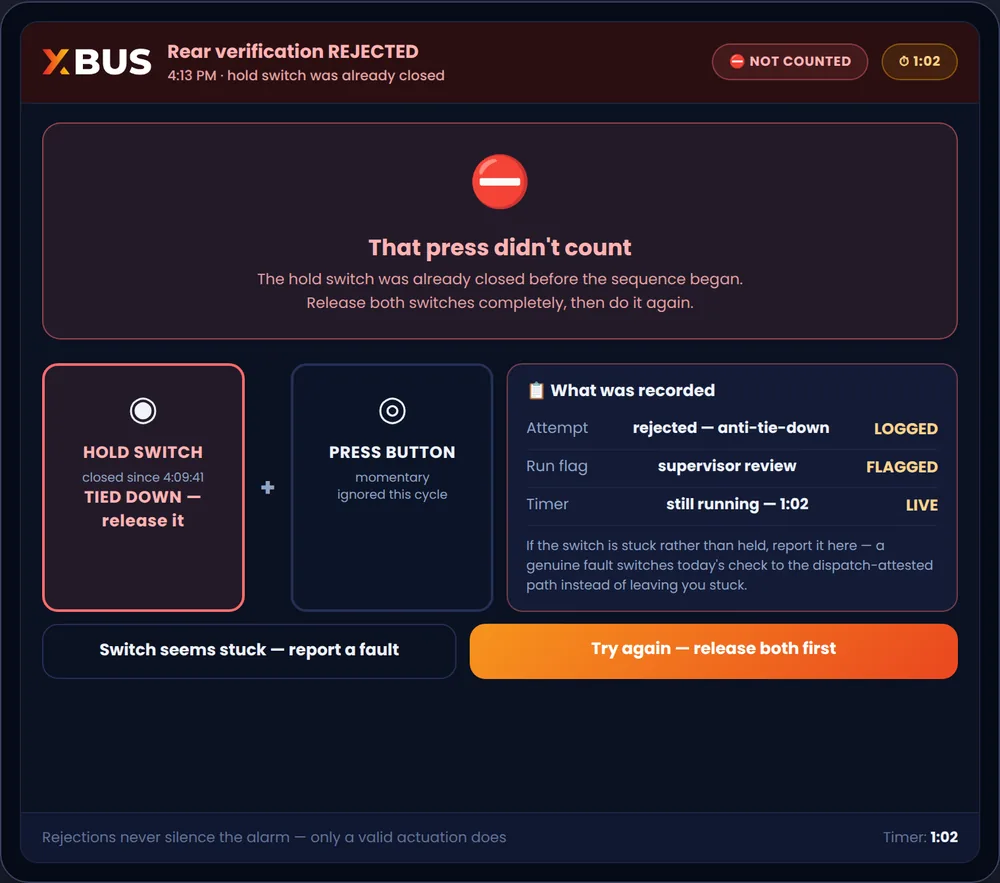
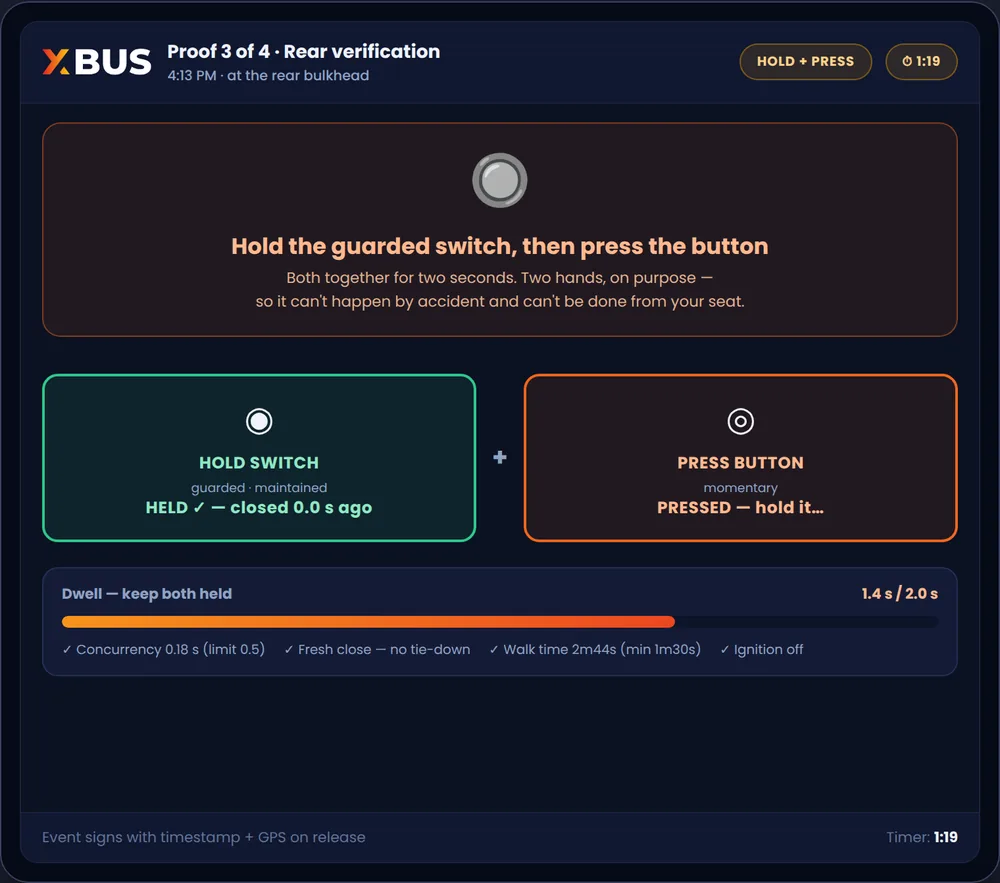
Each check fails differently, and each is a physical signal — a card, a timer, a switch, a sensor. That is deliberate: one system failing should never be able to produce a false “all clear.”
Every student card that tapped on has tapped off, or is explicitly accounted for by the driver.
A minimum duration scaled to the length of the bus. Walk it too fast and it does not count. Recorded on video as evidence for a person to review.
A hold-down switch and a momentary switch pressed together, at the back of the bus, inside the home-base geofence. A child cannot reach both.
Every fitted door sensor reads CLOSED — main, rear emergency, side. A rear door left ajar is how a child gets out unseen after the bus is parked.
XBus performs no automatic analysis of video. High-resolution cameras record continuously and footage is retained for 30 days so a person can retrieve it. Every check above comes from hardware — a card reader, a timer, a switch, a door sensor. Plate identification and any enforcement referral are made by people, not software.
We could tell you the camera sees the door. We would rather tell you the truth, because the truth is what holds up in front of a school board.
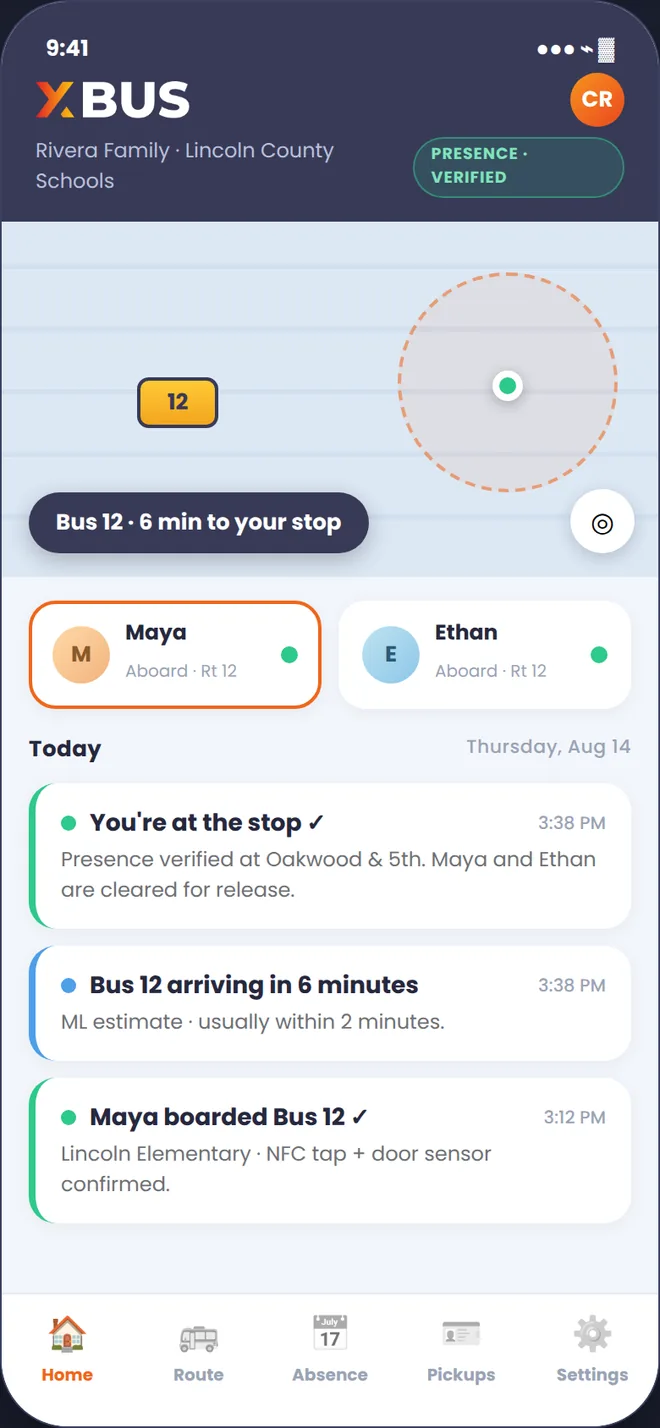
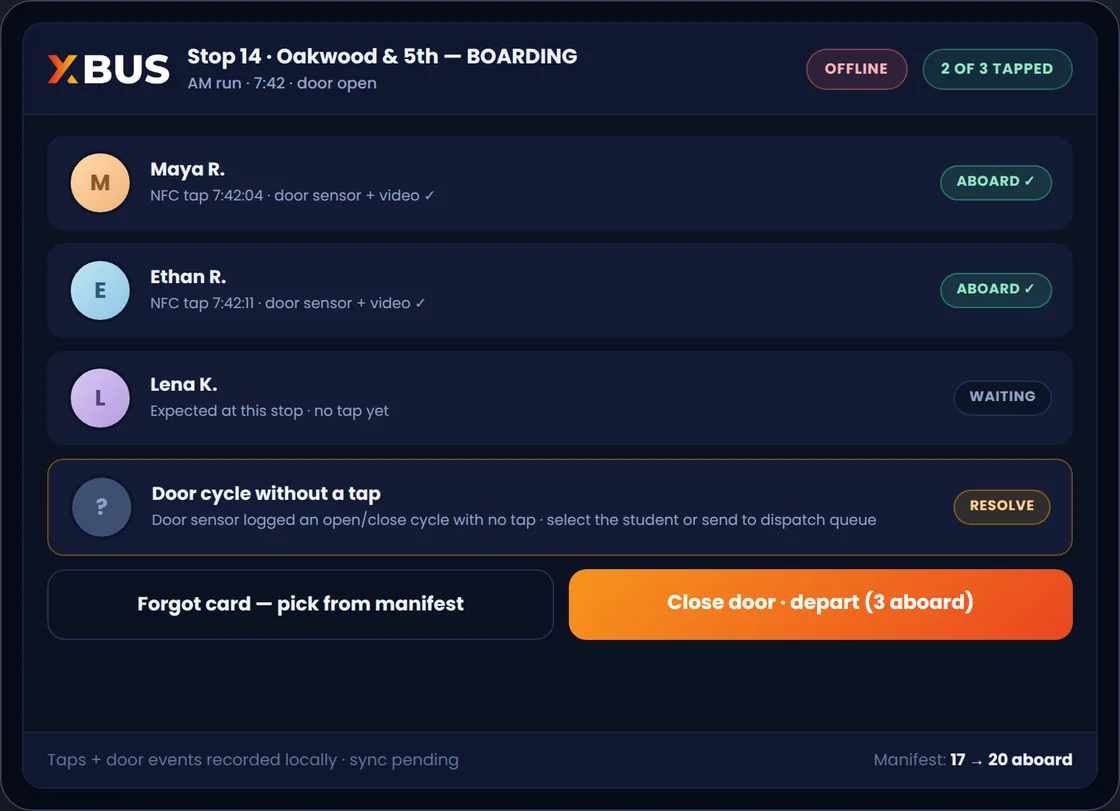
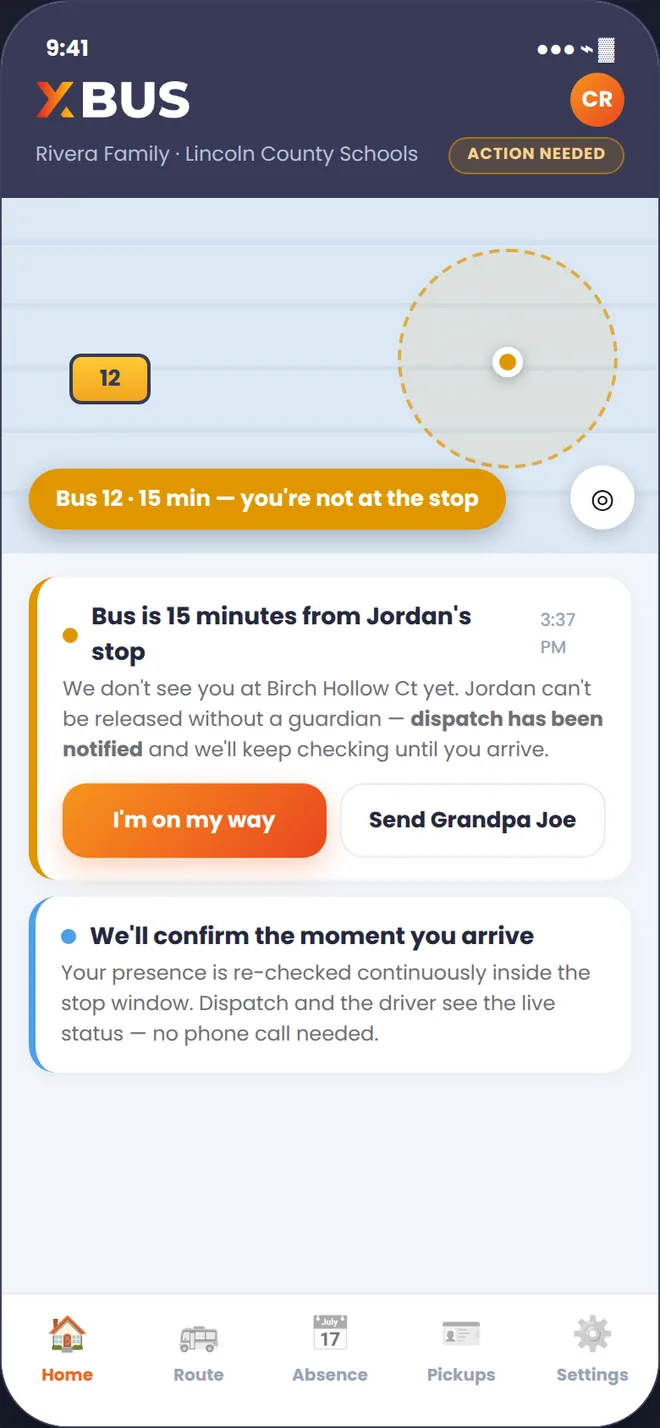
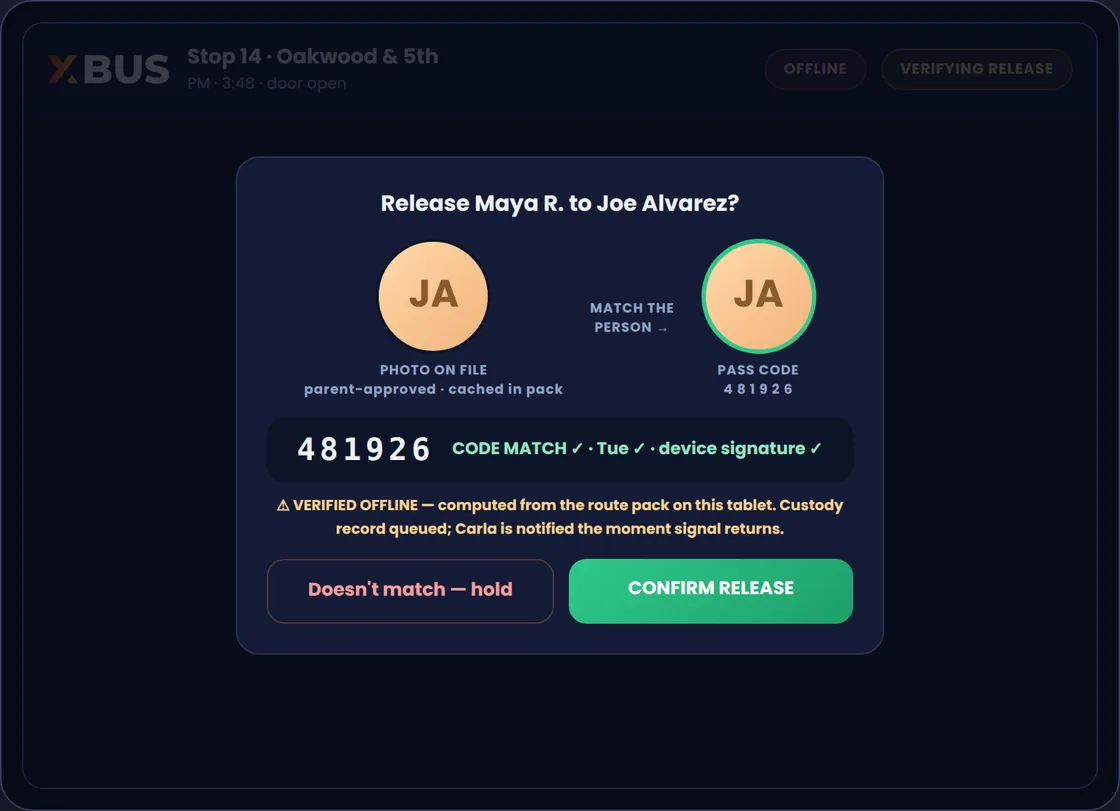
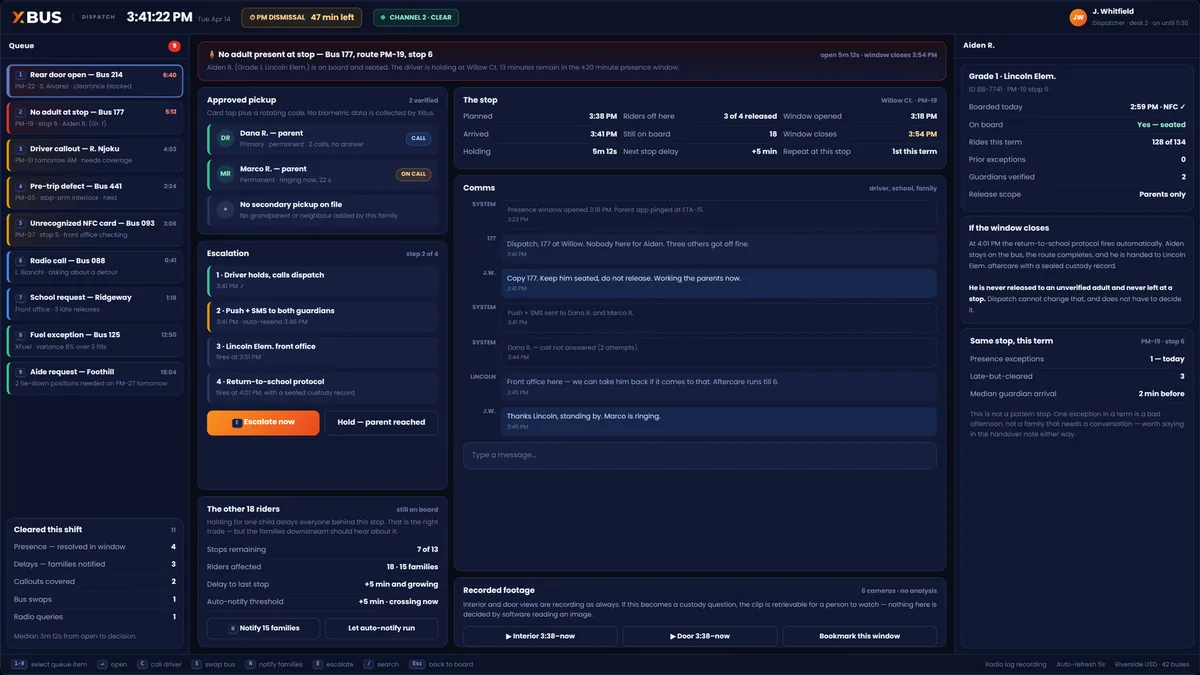
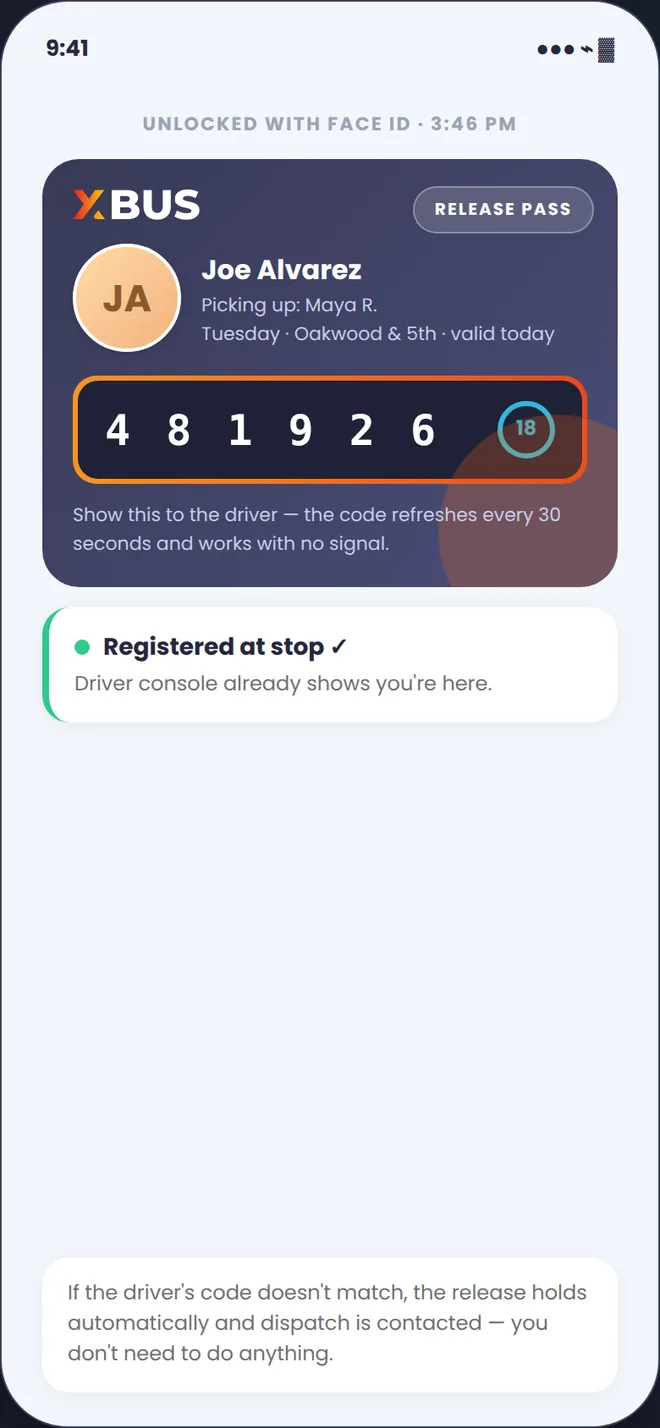
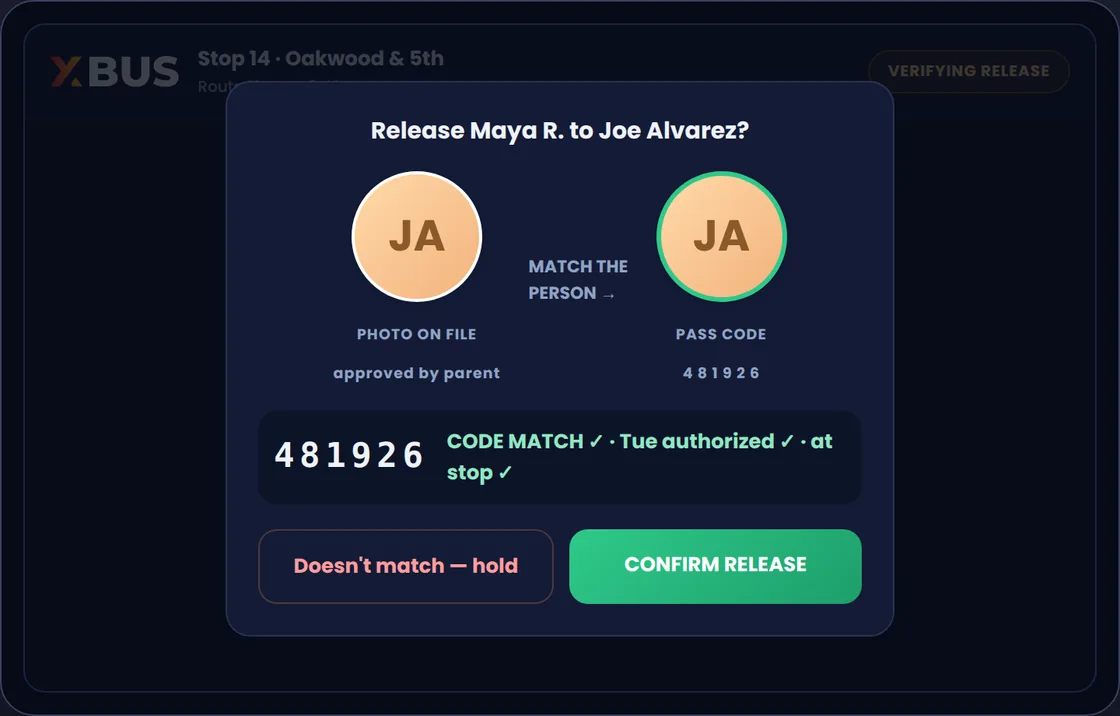
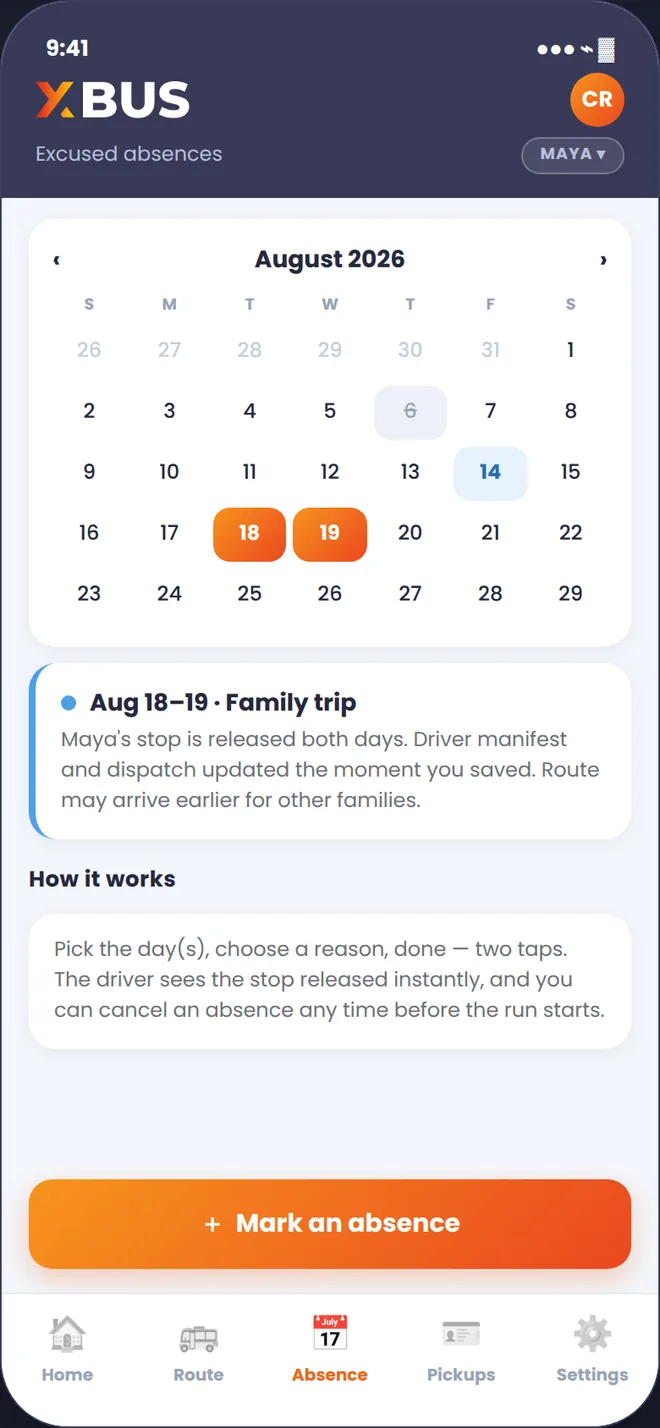
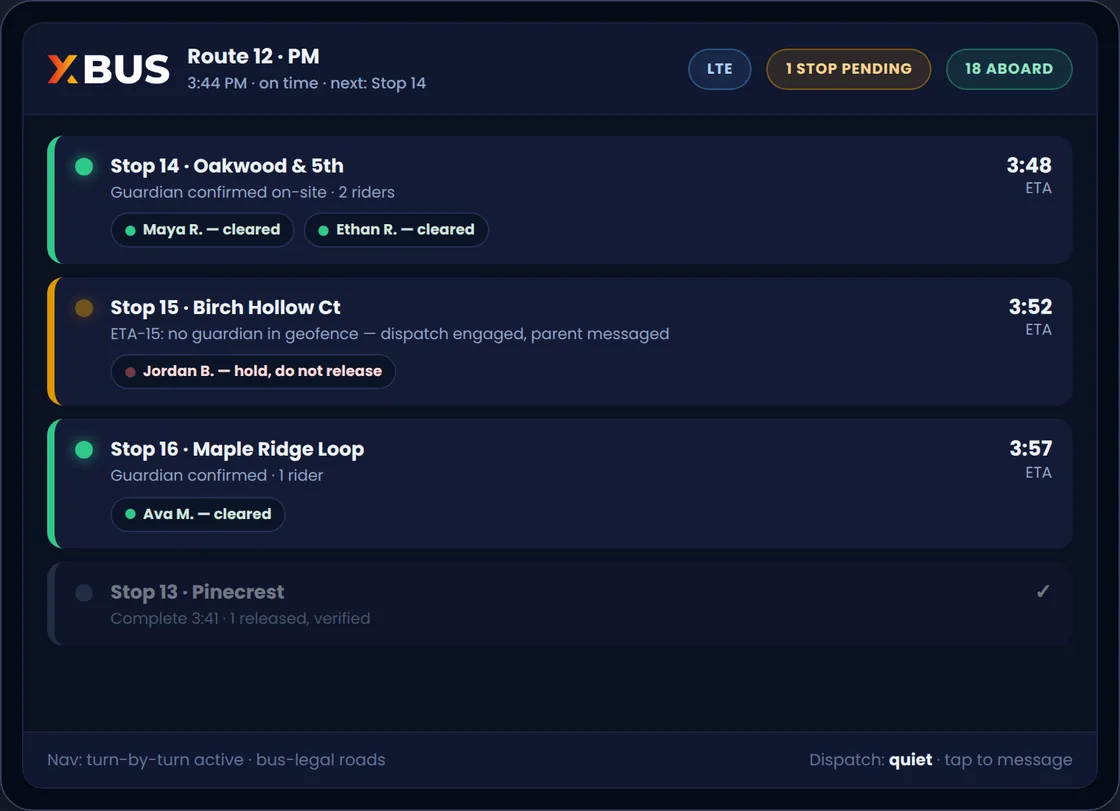
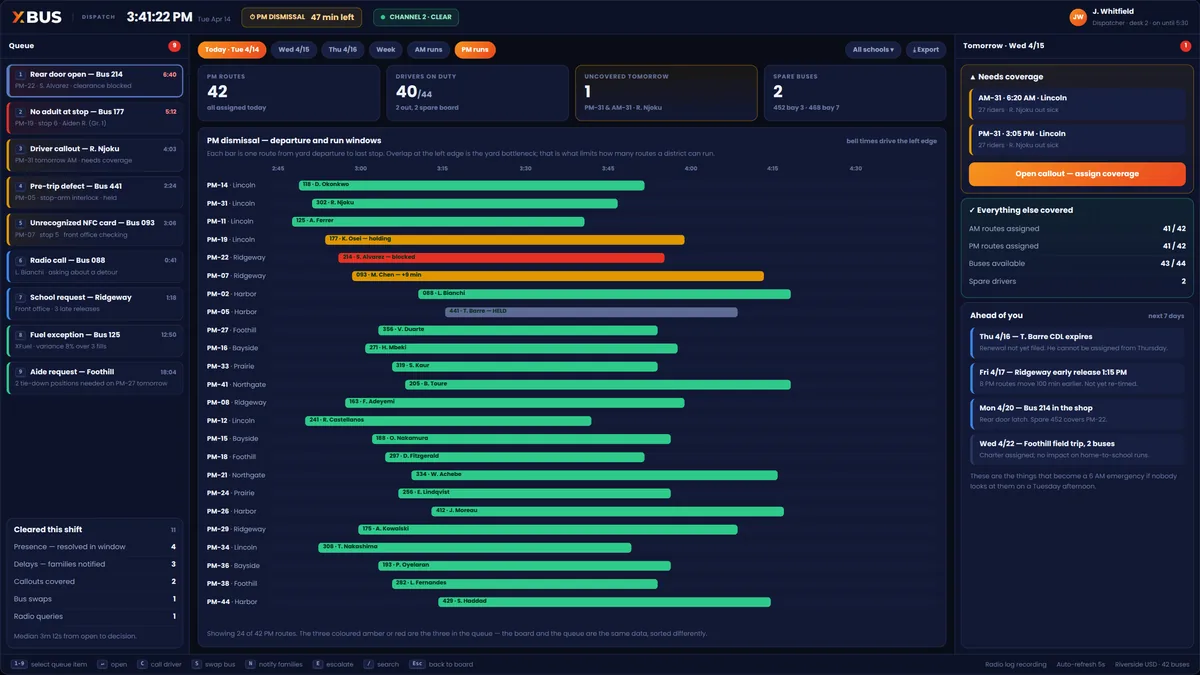
These are the real product screens, not illustrations. Every scene shows the same moment from the parent’s phone, the driver’s tablet and the dispatch desk — because they are reading the same record.
No phone call, no guesswork, no "did she get on?" text at 7:20. The card tap is the record, and it reaches the parent, the driver and the office at the same moment.


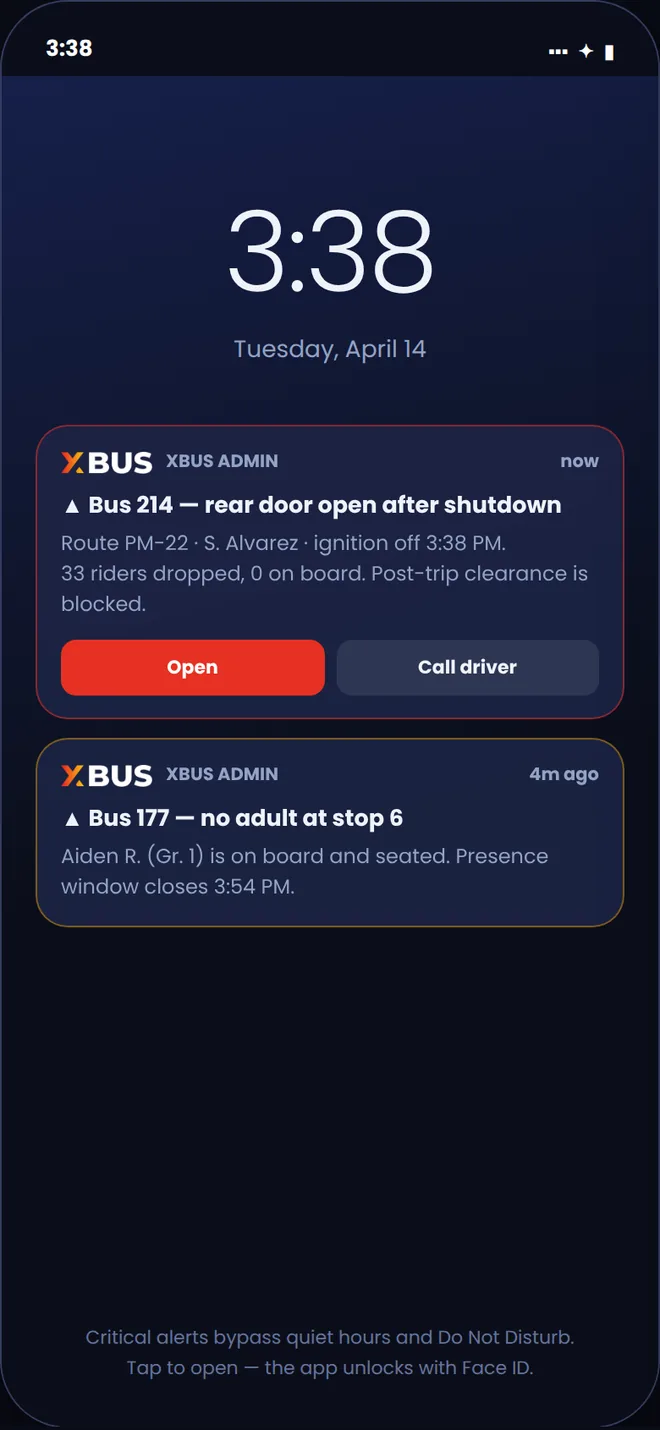
This is the moment districts lose sleep over. XBus turns it from a judgement call at the roadside into a procedure that runs on a clock and writes itself down.


The most common real-world exception is also the most awkward one. A parent grants a scoped pass in the app; the adult who turns up carries a code that changes every 30 seconds.


An absence filed before the run is worth more than an absence recorded after it. XRoute compresses the route, the driver never waits at an empty curb, and the fuel is simply never burned.


Ignition off. The driver is tired, the yard is busy, and this is exactly when a check gets skipped. So XBus does not ask the driver to remember — it refuses to advance.


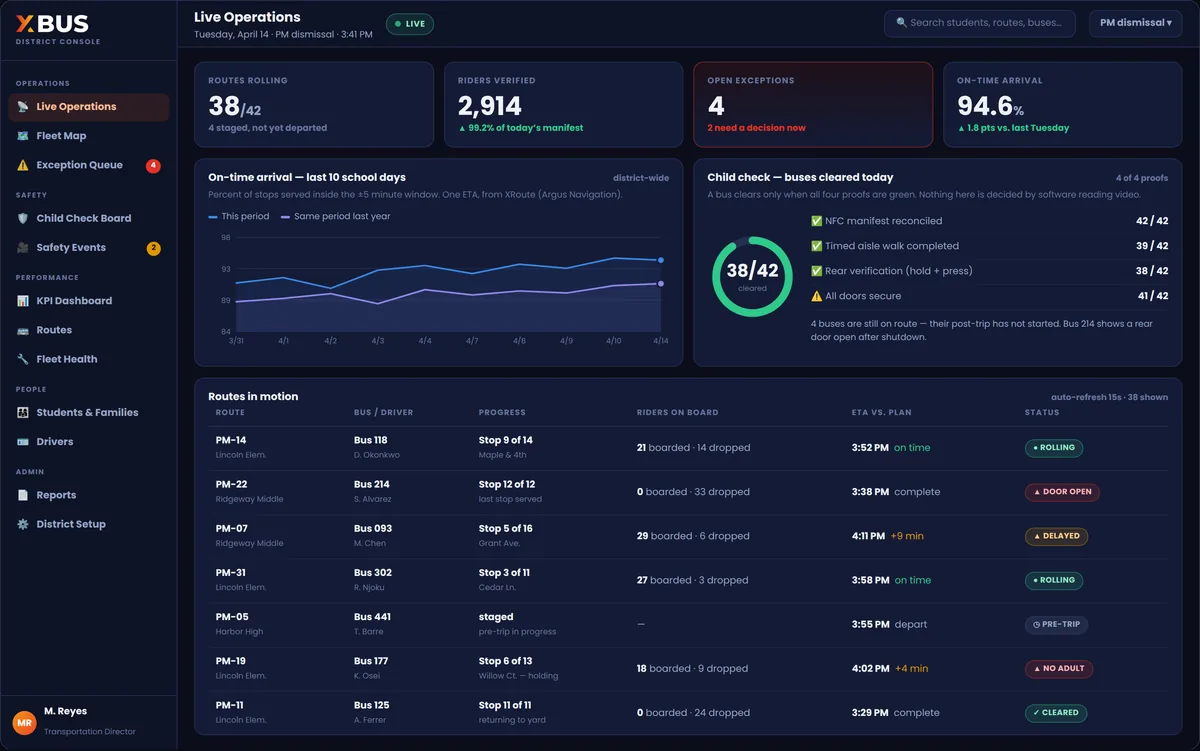
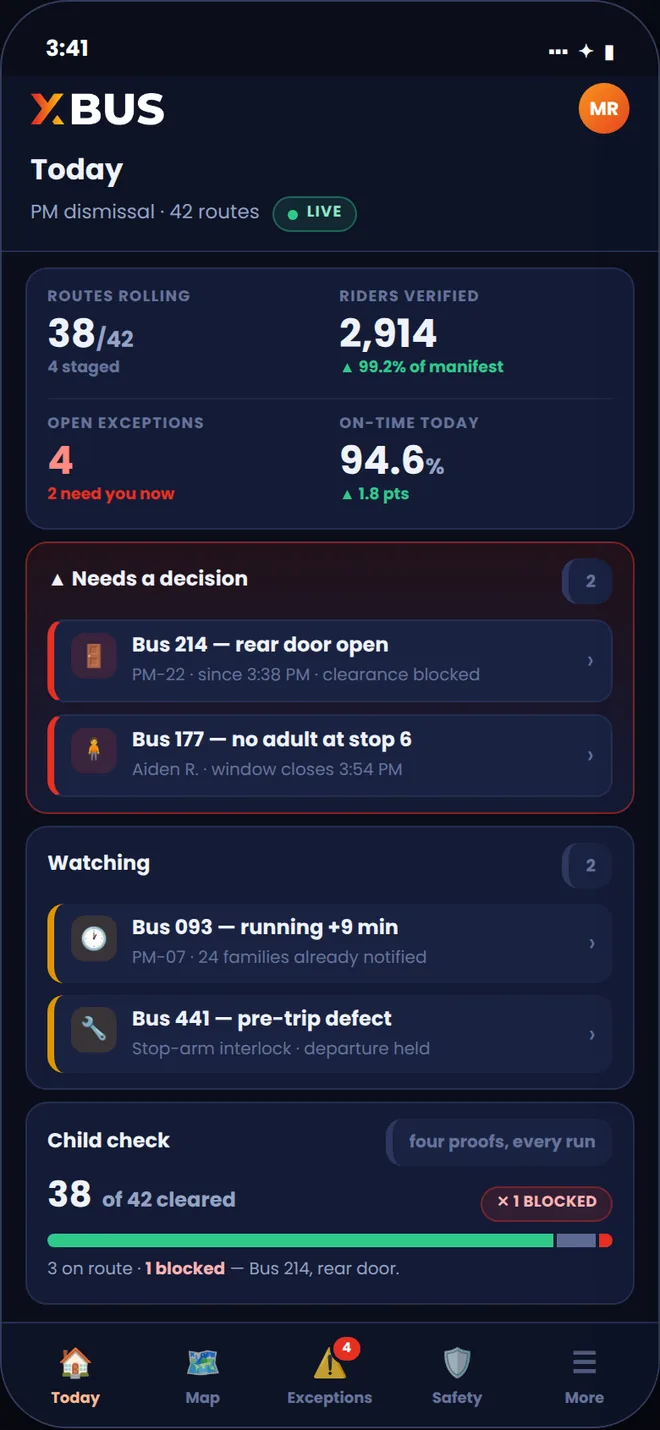
Everyone who touches a school bus gets the screen built for their job — and every one of them reads the same manifest, the same clearance state and the same ETA. There is no second version of the truth.
The bus, the ETA, and the proof that a child boarded — before a parent thinks to call.


A shift, not a menu. Eight phases from sign-on to secure-bus, and it will not let you skip one.
The dashboard you leave open all day: live operations, exceptions, KPIs, compliance.


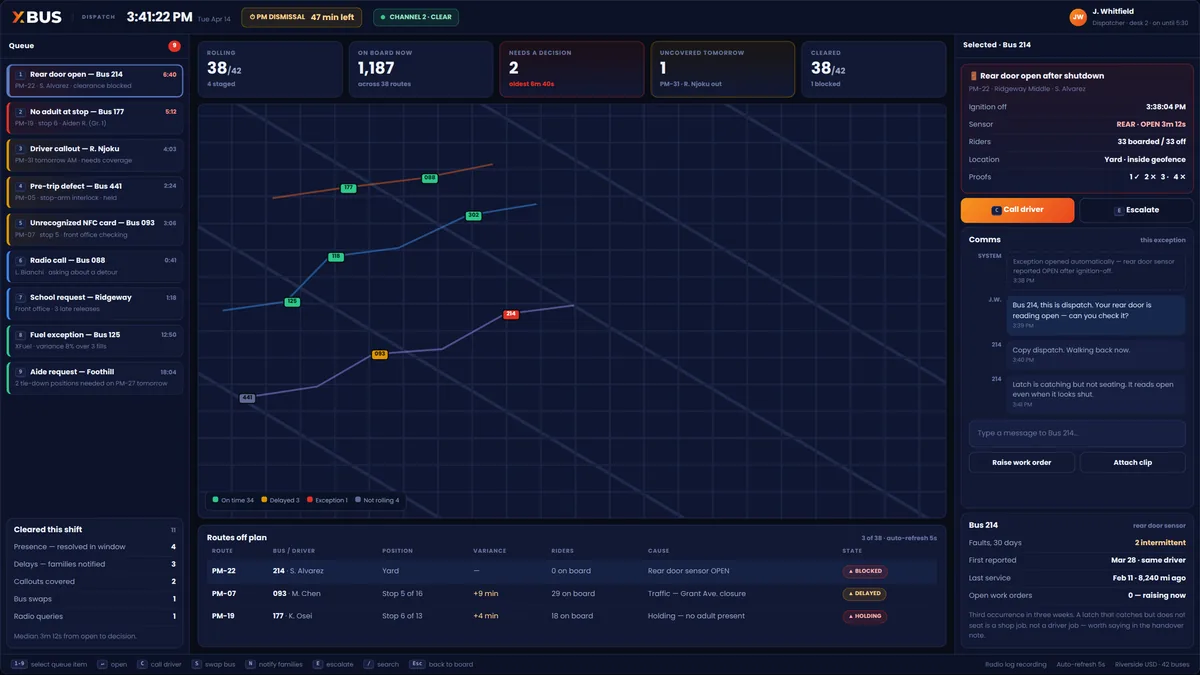
Because a director is not at a desk at 3:38 PM. Built for the ninety seconds between an alert and a decision.
Built like a desk, not a dashboard. A queue that ages, a work area, a comms panel, keys on the strip.

Fuel, maintenance, dispatch and routing on one ledger — so the finance office and the safety board read the same numbers. XRoute powered by Argus Navigation gives every surface one ETA. XFleet catches faults before a road call. XFuel reconciles nightly and XShield handles claims.
A safety platform that quietly tracks families is not a safety platform. These are architectural commitments, not settings — they are how the software is built.
The family app answers exactly one question — is an approved adult at the stop? — and only during the twenty minutes either side of a scheduled arrival. Outside that window the app transmits nothing at all. Inside it, it sends a single yes or no. No coordinates, no track, no history.
Identity at a bus door is a card tap plus a rotating code, and a driver comparing a face to a photo the parent chose and approved. Any fingerprint or face check happens on the guardian’s own phone and returns a yes or no. XBus never receives, stores or transmits a biometric template.
If an approved pickup adult changes their device, phone number or photo, their pass suspends immediately and stays suspended until the child’s parent approves the change. Unapproved changes expire in 72 hours and the previous state returns.
Every boarding, drop and release is written once and never edited — only annotated, hash-chained and retained for seven years. When a district needs to show exactly what happened on a Tuesday in March, it takes minutes.
Five surfaces, every hardware integration, unlimited district staff, and the audit-ready record behind all of it. No per-module pricing, no per-seat licences, no charge for the app a parent downloads. Volume pricing available for larger districts.
Thirty minutes, your fleet size, your bell times. We will walk a real dismissal window end to end — driver, parent, dispatch and director — and show you exactly what happens when a door is left open.